[CogSci26] Overhang Tower: Resource-Rational Adaptation in Sequential Physical Planning
Abstract
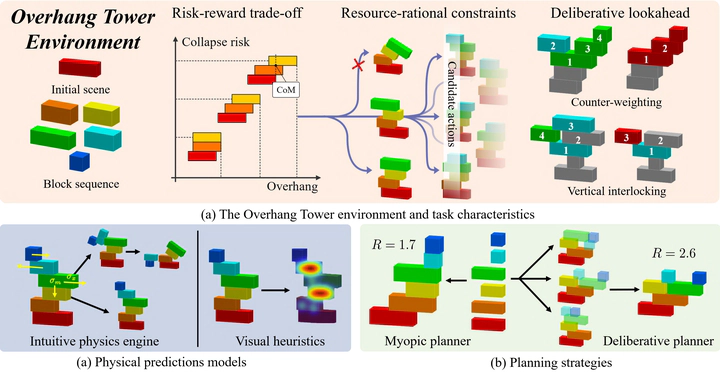
Humans effortlessly navigate the physical world by predicting how objects behave under gravity and contact forces, yet how such judgments support sequential physical planning under resource constraints remains poorly understood. Research on intuitive physics debates whether prediction relies on the Intuitive Physics Engine (IPE) or fast, cue-based heuristics; separately, decision-making research debates deliberative lookahead versus myopic strategies. These debates have proceeded in isolation, leaving the cognitive architecture of sequential physical planning underspecified. How physical prediction mechanisms and planning strategies jointly adapt under limited cognitive resources remains an open question. Here we show that humans exhibit a dual transition under resource pressure, simultaneously shifting both physical prediction mechanism and planning strategy to match cognitive budget. Using Overhang Tower, a construction task requiring participants to maximize horizontal overhang while maintaining stability, we find that IPE-based simulation dominates early stages while CNN-based visual heuristics prevail as complexity grows; concurrently, time pressure truncates deliberative lookahead, shifting planning toward shallower horizons: a dual transition unpredicted by prior single-mechanism accounts. These findings reveal a hierarchical, resource-rational architecture that flexibly trades computational cost against predictive fidelity. Our results unify two long-standing debates (simulation vs. heuristics and myopic vs. deliberative planning) as a dynamic repertoire reconfigured by cognitive budget.

Shiqian Li
Ph.D. '22