[Science26] A sub–10-millisecond neural dynamical system based on phase-change memristors
Abstract
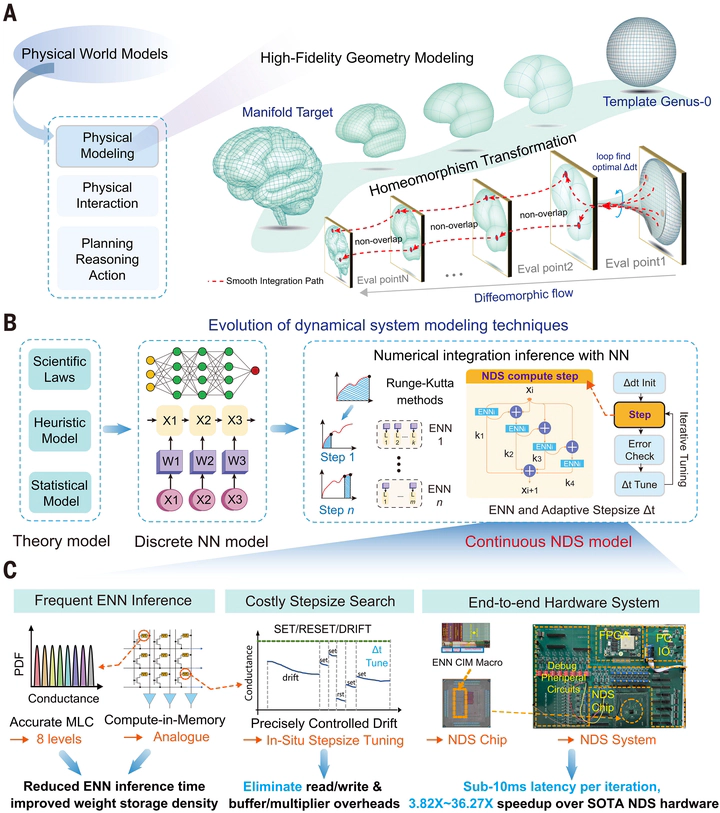
High-fidelity geometry for physical-world modeling demands real-time, dense, and differentiable deformation fields on manifolds. Neural dynamical systems (NDSs) using adaptive stepsize integration with embedded neural networks excel at these tasks but still suffer latency on the order of hundreds of milliseconds. In this work, we report a sub–10-millisecond NDS hardware leveraging the precisely controlled conductance drift of phase-change memristors and their multilevel compute-in-memory capabilities. We fabricated a 40-nanometer NDS chip for the challenging surface reconstruction tasks. Compared with state-of-the-art NDS hardware, our NDS design achieves a latency of 2.12 milliseconds (below 10 milliseconds) for single-iteration NDS computations with an error tolerance of 10−7 and delivers 3.82× to 36.27× faster speed while consuming 11.75× to 24.73× less power. The end-to-end NDS latency through hardware measurements and simulations outperformed graphics processing unit A100 by 50.38× to 478.18×.

Yaoyu Tao
Assistant Professor

Shiqian Li
Ph.D. '22