[CogSci26] Multi-Level Narrative Evaluation Outperforms Lexical Features for Mental Health
Abstract
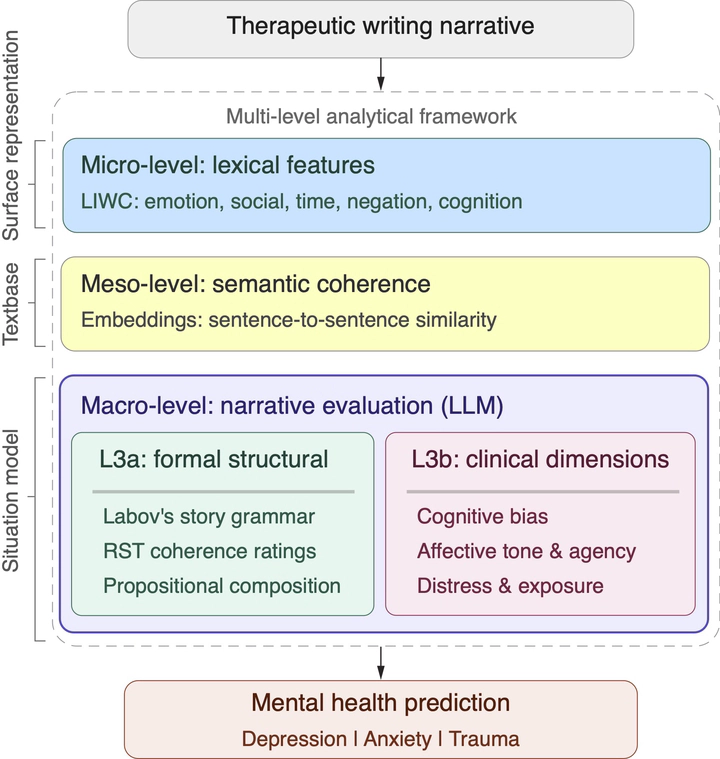
How people narrate their experiences offers a window into how the mind organizes them. Computational approaches to therapeutic writing have evolved from lexical counting to neural methods, yet remain fragmented: dictionary tools miss discourse structure, while embeddings conflate local coherence with global organization. No existing framework maps these techniques onto the hierarchical processes through which narratives are constructed. Here we introduce a three-level framework—micro-level lexical features, meso-level semantic embeddings, and macro-level Large Language Model (LLM) narrative evaluation—and show, across 830 Chinese therapeutic texts spanning depression, anxiety, and trauma, that macro-level evaluation substantially outperforms lexical and embedding features for mental health prediction. This challenges the field’s emphasis on word-counting: formal structural features (Labov’s story grammar, Rhetorical Structure Theory (RST) coherence, propositional composition) demonstrate that narrative organization per se carries predictive signal, while clinically-grounded narrative dimensions capture how psychological states are expressed through discourse. Semantic embeddings add minimal independent value but yield incremental gains in multi-level classification. By grounding computational levels in discourse processing theory, this framework identifies macro-structural organization as the primary locus of clinical signal and generates testable hypotheses for intervention design and longitudinal research.

Yuxi Ma (Yuki)
Ph.D. '24
My research interests include psychology-inspired AI research to understand and model human behavior and cognition, as well as investigating machine creativity and its applications in art.

Jieming Cui
Ph.D. '23

Chi Zhang
Assistant Professor